

Compliance is not just a bureaucratic formality. It makes the difference between smooth business operations and facing sudden disruptions such as losing payment processing, getting blocked in key markets, or even disappearing from search and hosting services overnight. Recent enforcement actions in multiple regions underline the importance of compliance: in the US, the FTC imposed a $1 million civil penalty on OnlyFans parent Fenix International for its subscription practices; in the EU, Meta was fined €1.2 billion by Ireland’s Data Protection Commission under GDPR for mishandling user data; and in the UK, Ofcom can fine platforms up to £18 million or 10% of global annual revenue under the Online Safety Act framework. For further context, read our adult web hosting insights.
A compliance failure rarely appears as a single legal bill. Instead, it shows up as frozen merchant funds, affiliate account suspensions, hosting complaints, domain pressure, or geo-block orders that cut off traffic in profitable regions. For a subscription site, even a short delay in payment processing can wipe out cash flow needed for ads, creator payouts, and refunds.
Trust also plays a significant role. Clear age gates, transparent billing descriptors, and complete legal pages reduce disputes arising from unauthorized transactions. Fewer chargebacks lead to lower processor risk scores, minimized reserve requirements, and a more stable business overall. This stability starts with getting compliance right from the start.
Adult-site compliance rests on five critical systems that must work in concert before a site can safely scale its traffic, billing, and content publishing efforts.
Age verification is essential as it controls legal access to the site. In some regions, a simple “18+ enter” splash screen is not sufficient; many regulators now expect stronger checks, such as ID-based confirmation, card verification, mobile-network checks, or third-party age-estimation tools. The question to ask isn’t just, “Do I have a gate?” but rather, “Can I show that I took reasonable steps given the visitor’s location?” For more legal guidance, see our Adult Content Laws: Age Verification & Compliance Guide.
Record-keeping serves as the evidence layer. Detailed documentation is required to show that performers are of legal age, have consented to the distribution of their content, and that user data and transactions are handled lawfully. This includes maintaining organized identity records, model releases, publishing permissions, and audit trails that accurately reflect what is live on the site.
This pillar defines what content is legally publishable. Mistaken assumptions about content ownership can lead to copyright claims, issues with non-consensual content, violations around banned categories, or conflicts with local obscenity standards. Each of these can quickly turn a profitable asset into a legal liability.
Financial compliance is closely linked with content policy. Adult businesses typically fall under high-risk categories, subjecting them to strict KYC (Know Your Customer) checks, enhanced underwriting, rolling reserves, and heightened oversight of chargebacks. Poor document management or unclear refund practices can result in unstable payment processing.
Effective privacy practices and clear disclaimers are key to tying the compliance framework together. This means having clear Terms of Service, a privacy policy that truly reflects your data handling practices, consent management tools for regions like the EU or California, and explicit content warnings. These practices reduce legal ambiguities before they escalate into major issues.
If your site targets traffic from multiple countries, your compliance strategy should not be based solely on your home jurisdiction. The table below outlines the operational parameters every site owner should consider before launch, including the minimum age requirements, expected verification methods, record-keeping durations, and associated penalty ranges.
| Jurisdiction | Age Threshold | Verification Method | Record-Keeping Duration | Penalty Range |
|---|---|---|---|---|
| United States | 18 for performers in federally regulated explicit content; rules vary by state | Government ID, facial age estimation, or third-party AV providers for access; identity documentation for producer records | As long as the content is published plus a post-operation period | Fines, imprisonment, injunctions, or state-specific penalties |
| European Union | 18 in most member states for pornographic content | Proportionate age assurance per local rules with GDPR compliance | As required for legal compliance under GDPR | Up to €20 million or 4% of global turnover |
| United Kingdom | 18 | Document checks, payment-card checks, mobile-network checks, or facial age estimation | Evidence must be retained as long as legally justified | Up to £18 million or 10% of global revenue |
| Canada | 18 federally, with provincial variations | Moving to meaningful age assurance beyond click-through warnings | Maintain records as long as legally necessary | Fines and court orders based on statute |
| Australia | 18 | Enhanced age assurance measures given rising expectations | Only keep data as required for compliance within privacy-law limits | Significant civil penalties and regulatory orders |
The takeaway is straightforward: while the minimum age is clear, proving that your verification and record-keeping systems are effective is the real challenge. Both the US and UK enforce strict access controls, while the EU’s privacy regulations add further complexity to verification processes.
Use this matrix as a tool to help plan your site’s compliance strategy—not as a replacement for legal counsel. Operating in multiple regions may best be approached by setting a global default of 18+ access, deploying stronger verification methods in high-risk jurisdictions, and clearly documenting your data retention decisions.
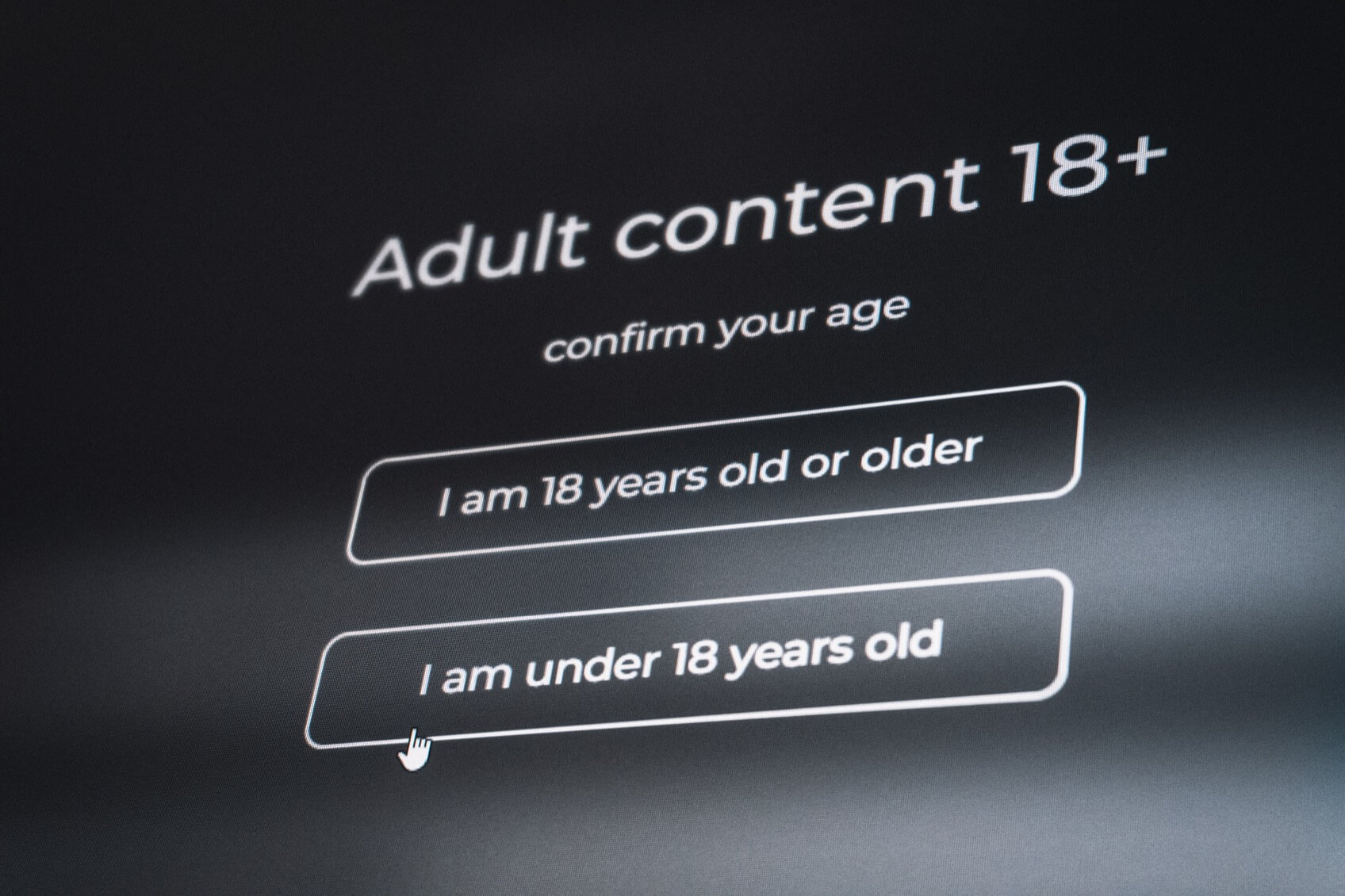
Choosing the appropriate age-verification method is essential. The preferred solution must hold up under strict regulations without collecting more personal data than necessary. Here are three primary methods:
Document ID checks—often combined with a selfie or liveness test—offer the highest level of assurance by verifying the authenticity of government-issued documents while ensuring the user is present. While this method meets high regulatory standards in the US, UK, and other markets, it tends to be more complex to integrate and requires careful data protection measures.
Payment card verification can serve as a lighter age signal in markets where card ownership is generally associated with adulthood. Although quicker for users and easier to implement, it offers a lower level of assurance compared to document-based approaches and should be treated only as a proxy for age verification.
Biometric age estimation methods, including facial scans without full ID uploads, are gaining traction, particularly in the UK and EU. These methods aim to reduce the data collected while still verifying age, though they may struggle with accuracy near legal age boundaries. Since each additional verification step might reduce user conversions, it is important to find a balance between legal safety and user experience.
When regulators ask how you verify that every performer was an adult when the content was created, a detailed response is required. In the US, this is mandated by 18 U.S.C. §2257 and 28 CFR Part 75, which necessitate keeping detailed records—including legal names, aliases, dates of birth, and government-issued photo IDs—for all explicit content.
Other regions, such as Canada and the UK, may not have an exact equivalent to §2257, but operators are expected to maintain thorough documentation (including IDs, model releases, and production details) to defend against potential audits. Adopting US-style record-keeping practices can serve as a proactive measure even where not legally required.
| Jurisdiction | Core Law | Required Fields | Retention Duration |
|---|---|---|---|
| United States | 18 U.S.C. §2257; 28 CFR Part 75 | Legal name, aliases, DOB, government-issued photo ID, and linkage of performer to content | For as long as the content remains published |
| Canada | Criminal Code considerations | Age proof, legal identity, consent/model release, production details, licensing trail | As long as legally defensible |
| United Kingdom | Obscene Publications Act 1959 | Documentation including ID, consent, age proof, and publication metadata | Maintain records to justify published content |
This record-keeping not only meets legal standards but also simplifies subsequent payment and banking compliance processes.
Payment processing for adult sites carries its own set of challenges. Due to the high-risk classification, processors may impose measures such as rolling reserves, delayed settlements, or even account termination after escalating chargebacks. Securing an adult-capable merchant setup in advance is critical.
Options typically include acquiring high-risk merchant accounts from traditional banks or opting for payment facilitators who specialize in adult businesses. Standard processing fees range from 4% to 10% plus a per-transaction fee, with rolling reserves generally between 5% and 15% held for 90 to 180 days. These factors can cause the net revenue to differ markedly from the advertised subscription price.
Before launch, complete full KYC (Know Your Customer) and AML (anti-money laundering) verifications. Be prepared with documentation such as company registration details, owner IDs, bank statements, a clear refund policy, and accurate billing descriptors. Clear legal pages and transparent billing practices further reduce the likelihood of chargebacks and stabilize payment processing.
Legal pages on an adult site must serve two purposes: reducing regulatory ambiguities and setting clear expectations for users. Basic templates rarely suffice. Your Terms of Service should incorporate clauses covering age verification, lawful access, usage limitations, and liability.
Similarly, the privacy policy needs to accurately represent your data handling practices under regulations like GDPR and CCPA/CPRA. An explicit content disclaimer should be prominently displayed before any content loads, ensuring users recognize the nature of the site and reducing potential legal disputes. For more insights on policy drafting, check out our Adult Website Hosting: What You Should Know in 2025.

Your data handling practices must align with your published policies. Categorize data according to its purpose, establish defined retention periods, and ensure regular backups. Consider three main data categories: user IDs and consent logs, server/application logs, and media files coupled with performer records.
| Data Type | Purpose | Retention Logic | Backup Frequency |
|---|---|---|---|
| User IDs, signup metadata, consent logs | Fraud review, dispute resolution, legal proof of consent | Retain only as long as necessary for chargebacks and legal claims | Daily |
| Access logs, age-gate events, admin activity logs | Security and abuse investigation | Short-term retention unless legally required to extend | Daily with a defined purge schedule |
| Media files, model releases, identity records | Proof of licensing, consent, and lawful distribution | Retain as long as content is live plus any legally required hold | Daily with off-site backups |
Regular backups and a defined incident-response workflow (including evidence preservation and logging) are essential to maintain compliance in case of a regulatory inquiry or legal hold.
Hosting infrastructure is a crucial element of compliance. Decisions on server location, content distribution, and data security impact legal obligations. For instance, hosting sensitive age-verification data in jurisdictions with strict privacy laws can introduce additional compliance challenges if not handled properly.
Deploying a DNS Anycast CDN can help reduce latency by serving static assets from strategic edge locations, while ensuring that sensitive data remains stored in appropriate regions. Additionally, using SSL everywhere and strong DDoS protection safeguards user data and meets security requirements. Midway through this discussion, it’s worth considering that SiteValley’s Adult Hosting plan (from $59.40/yr) provides a dedicated solution designed for adult content. It includes cPanel, free SSL, free DNS Anycast, and daily backups, making it a viable option for sites that need to meet compliance standards without compromising on performance.
Ensuring that your hosting environment continually meets compliance standards is an ongoing process. For technical insights on hosting sensitive content, you may also find our guide on Adult Image Hosting: Hosting NSFW Galleries the Smart Way useful.
What is the importance of compliance for adult websites?
How do age verification methods affect adult sites?
What records should be maintained for legal compliance?
How do hosting decisions impact compliance on adult sites?
What challenges do adult sites face with payment processing?

Quick Customer care response, accurate and broad assistance, easy to use client area.....
I am very happy with the service. I am with site valley for many years and at the present usimg 2 hosting packages. Their service is excellent and super fast. Thanks & Greatly Appreciated
I've been hosting my websites with Sitevalley for more than 6 years. Very satisfied with the services and reliability they provide, competitive prices, almost no downtime, fast and knowledgeable customer support.
I have been using side valley for a couple of years now and have to say I am very happy with the service they offer.I use many Hosting services but site valley stands out in front. Reliable service, great support.I don't normally leave reviews but felt I wanted to for this service as it has been fantastic
I didn't want to review so soon on into taking out hosting with site valley but I feel obliged because their customer service is outstanding, second to none, every time I had an issue it was sorted immediately. I would highly recommend Site Valley.
I have been with Sitevalley for over a year and it's the best hosting I have EVER used. And I have been through a lot of them.
The support staff are amazing, and it's clear that they have a passion for hosting websites. I've rather enjoyed this webhosting company and it's stability for the price is bar-none, amazing.
My collegue adviced me to use SiteValley as a reliable hosting provider with great prices, professional and fast Customer Service. My experience with SiteValley was exactly the way I was promised.
I have been with SiteValley for many years, and plan to stay with them for many more. Customer support is very responsive and knowledgeable.
SiteValley.com is rated 4.8 / 5 based on 329 Reviews »

© 2001 – 2026 SiteValley.com. All Rights Reserved.
