

AI has moved into mainstream content production because using AI for content writing solves practical problems that many teams face daily. Content calendars are fuller than ever, publishing cycles are shorter, and audiences expect frequent updates across multiple channels. Producing that volume manually is slow and expensive, especially for small teams or solo creators. This is one of the main reasons creators are increasingly using AI for blogging to keep up with publishing demands. AI helps reduce friction in early drafting and ideation, making large workloads more manageable.
Another major factor behind AI adoption is consistency. Businesses want predictable structure, tone, and baseline quality across all content. While AI cannot replace editorial judgment, it can standardize repetitive elements and speed up production cycles. This allows human writers to focus on insight, clarity, and relevance instead of raw output.
Using AI for content writing refers to using machine learning models to assist with generating written text. These systems analyze large datasets of language and predict what text should come next based on patterns. This makes them useful for drafting, summarizing, rewriting, and structuring content when given clear instructions.
AI does not understand meaning, truth, or intent in the same way humans do. It cannot evaluate sources, judge importance, or reason about consequences. Because of this, AI-generated text should always be treated as a draft. Human writers remain responsible for accuracy, tone, and ensuring that content serves a real audience need.

AI works best when it supports specific stages of content creation rather than trying to handle the entire process end to end.
Using AI for content writing can reduce workload and improve efficiency, but it also introduces risks that require active oversight.
AI significantly shortens the time needed to produce first drafts and boilerplate content. Writers can spend more time refining ideas, improving clarity, and adding real insight instead of repeating the same structures. This is especially valuable for high-volume content like blogs, category pages, and support articles. The efficiency gains are particularly noticeable when using AI for blog posts that require frequent publishing. Over time, this speed advantage compounds and allows teams to publish more consistently.
AI helps overcome writer’s block by suggesting angles, headings, and alternative phrasing. This keeps projects moving forward, especially under tight deadlines or high output demands. It also helps writers explore perspectives they may not have considered initially. The result is often a stronger starting point rather than a perfect final draft.
Without strong prompts and examples, AI-generated text often sounds bland or interchangeable. Maintaining a distinct brand voice still depends on human guidance and editing. This is particularly important for brands that rely on personality or authority. Without oversight, content can lose its unique identity over time.
AI can produce information that sounds plausible but is incorrect or entirely fabricated. Fact checking remains essential before publishing any AI-assisted content. These errors are not always obvious, which increases risk if content is published unchecked. Editorial review protects credibility and trust.
AI delivers the best results when humans define goals, constraints, and quality standards. Treating AI as a collaborator rather than an authority produces better outcomes. Clear direction improves relevance and reduces cleanup work later. Human judgment remains the final filter for quality and responsibility.
AI tools are commonly used to support SEO tasks such as keyword research, topic clustering, and content outlining. They can analyze search patterns and suggest structures that align with common user intent, which helps content start from a solid foundation. This is especially useful when covering competitive or well-established topics where search expectations are already clear. AI can also help identify gaps in existing content by comparing topics and subtopics across top-ranking pages.
However, SEO performance still depends on usefulness and relevance rather than automation. Overreliance on AI-generated keywords or outlines can lead to content that feels forced, repetitive, or shallow. Search engines increasingly state that they prioritize helpful content written for humans over mechanically optimized text. Human review is necessary to ensure content flows naturally, answers real questions, and avoids over-optimization that can hurt rankings over time.

Clear guidance is essential for producing useful AI-generated content. Providing tone references, example paragraphs, and contextual instructions helps AI outputs align more closely with brand expectations. Without this guidance, results can vary widely in style, clarity, and structure, even within the same project. Consistency improves when prompts and examples are reused and refined over time.
Editorial standards remain critical regardless of how advanced AI tools become. This becomes even more important when using AI for website content, where consistency and accuracy directly affect trust and usability. Style guides, review processes, and fact-checking workflows help prevent inconsistencies and factual errors. Since AI can confidently produce incorrect or misleading information, human editors must always validate claims and sources. Quality control is not optional, especially for authoritative or commercial content where credibility matters.
AI-generated content raises concerns around originality, copyright, and responsible use. Because language models are trained on large datasets of existing text, there is a risk of generating content that is too close to published sources. Writers and publishers must ensure AI-assisted content is sufficiently original and does not infringe on intellectual property rights. This often requires manual rewriting and editorial judgment rather than direct publishing of raw outputs.
Transparency is another important factor when using AI for content creation. Some industries, clients, or jurisdictions require disclosure when AI tools are involved in producing content. Even when disclosure is not legally required, ethical use includes being honest about processes and maintaining accountability. Responsibility for accuracy, compliance, and potential harm always lies with the human publisher, not the tool.
AI adapts differently depending on the format being produced, and its strengths vary by use case.
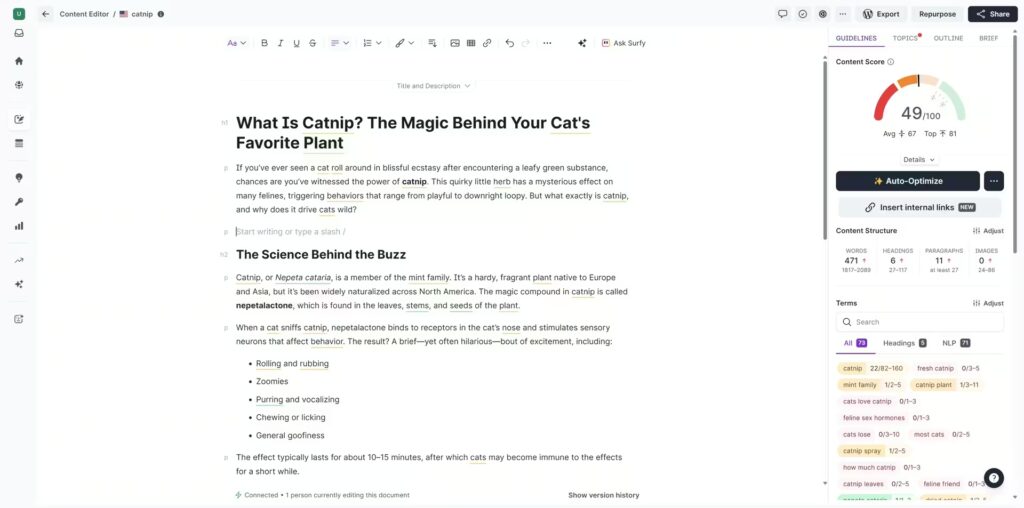
AI tools are expected to continue improving their ability to handle longer context and maintain coherence across complex content. Integration with image, video, and audio generation will further streamline content workflows. These advances will reduce production friction even more.
Despite this progress, AI will not replace strategic thinking or audience understanding. Writers who learn to guide AI effectively will gain efficiency advantages, but creativity, judgment, and responsibility remain human strengths. This balance is especially important for individuals using AI for blogging, where personal voice and consistency still matter. The future of content writing is collaborative, not automated.
Using AI for content writing is a powerful addition to modern content workflows when done with intention and control. It accelerates drafting, supports ideation, and helps teams scale output without sacrificing consistency. At the same time, it introduces risks that require strong editorial oversight.
The most effective content strategies combine AI efficiency with human expertise. When accuracy, relevance, and audience value remain the priority, AI becomes an advantage rather than a shortcut.
At SiteValley, we provide hosting solutions built for creators and businesses that need reliable performance and room to grow. Our infrastructure supports content-heavy websites with consistent uptime, responsive support, and straightforward management through cPanel. For projects that need flexibility and speed, our Cloud KVM2-US VPS plan with 2 vCPU cores, 4 GB DDR5 RAM, 40 GB SSD NVMe storage, unmetered bandwidth, and a free domain for new accounts offers a solid foundation for publishing and scaling content. We focus on dependable hosting so you can concentrate on creating, optimizing, and growing your content without infrastructure distractions.

Quick Customer care response, accurate and broad assistance, easy to use client area.....
I am very happy with the service. I am with site valley for many years and at the present usimg 2 hosting packages. Their service is excellent and super fast. Thanks & Greatly Appreciated
I've been hosting my websites with Sitevalley for more than 6 years. Very satisfied with the services and reliability they provide, competitive prices, almost no downtime, fast and knowledgeable customer support.
I have been using side valley for a couple of years now and have to say I am very happy with the service they offer.I use many Hosting services but site valley stands out in front. Reliable service, great support.I don't normally leave reviews but felt I wanted to for this service as it has been fantastic
I didn't want to review so soon on into taking out hosting with site valley but I feel obliged because their customer service is outstanding, second to none, every time I had an issue it was sorted immediately. I would highly recommend Site Valley.
I have been with Sitevalley for over a year and it's the best hosting I have EVER used. And I have been through a lot of them.
The support staff are amazing, and it's clear that they have a passion for hosting websites. I've rather enjoyed this webhosting company and it's stability for the price is bar-none, amazing.
My collegue adviced me to use SiteValley as a reliable hosting provider with great prices, professional and fast Customer Service. My experience with SiteValley was exactly the way I was promised.
I have been with SiteValley for many years, and plan to stay with them for many more. Customer support is very responsive and knowledgeable.
SiteValley.com is rated 4.8 / 5 based on 329 Reviews »

© 2001 – 2026 SiteValley.com. All Rights Reserved.
