
Running a restaurant today means operating with very little margin for error, which has made AI for restaurants a practical consideration rather than a futuristic concept. Ingredient costs fluctuate, staffing levels change unexpectedly, and customer tolerance for delays or mistakes is low. Even experienced operators often feel like they are constantly reacting instead of making deliberate, forward-looking decisions.
At the same time, restaurants are surrounded by data. Every order, modification, cancellation, shift change, delivery delay, and customer complaint is logged somewhere. Most of that information never gets looked at in a structured way. AI becomes relevant not because it is innovative, but because AI for restaurants can process this accumulated data consistently and turn it into signals that humans can actually act on. Without that translation layer, data alone does not improve operations.
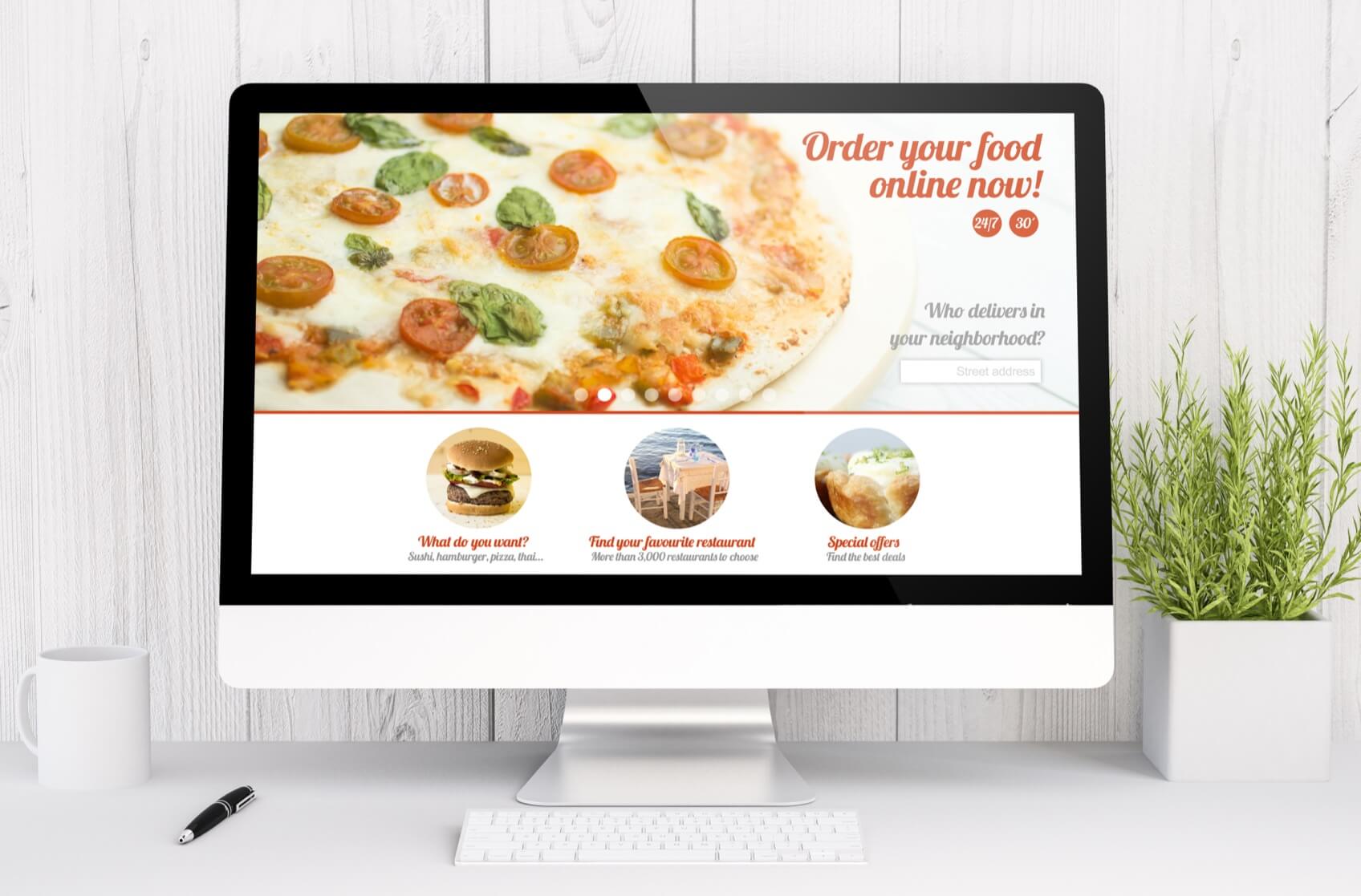
In this context, restaurant websites are not treated as standalone marketing pages, but as part of a broader digital system. Modern restaurant websites often power or integrate with online menus, ordering flows, reservation tools, analytics dashboards, and customer-facing personalization features. When AI is discussed throughout this article, it includes how these capabilities surface through restaurant websites and the systems connected to them.
In restaurants, AI for restaurants is almost always analytical software rather than physical automation. It does not cook food, greet guests, or manage staff directly. Its role is to analyze patterns across time and produce predictions, recommendations, or alerts that help managers make better decisions.
A crucial distinction is the difference between automation and AI. Automation executes predefined rules exactly as they are written. If conditions change, the system continues behaving the same way until someone manually intervenes. AI systems can adapt when inputs change, because their output is based on learned patterns rather than fixed thresholds, depending on how the system is trained and updated.
In practice, this means:
Many tools marketed as AI are closer to automation in reality. This distinction matters when evaluating the best AI software for restaurants, since not all solutions actually adapt to changing conditions. Understanding whether a system actually adapts over time helps set realistic expectations and avoid misplaced trust.

Operational decisions happen constantly and often under time pressure. Inventory ordering, prep planning, and purchasing decisions are made daily, sometimes multiple times per day. Small mistakes in these areas rarely cause immediate disasters, but they accumulate into significant losses over weeks and months.
AI tends to show value here first because AI for restaurants reduces uncertainty rather than trying to achieve perfection. It does not guarantee optimal outcomes, but it significantly reduces the frequency of bad ones. Instead of relying on intuition or short-term memory, managers get recommendations grounded in longer-term patterns.
Typical operational uses include:
AI analyzes historical sales, seasonal variations, and recent demand shifts to estimate realistic inventory needs. This helps avoid overordering that leads to spoilage and underordering that causes last-minute shortages.
By comparing prep volumes with actual sales over time, AI identifies items that are consistently over-prepared. This allows kitchens to adjust batch sizes and prep timing before waste becomes routine.
AI looks at patterns across days, weeks, and months, including the impact of events or weather. This supports better planning for staffing, purchasing, and prep instead of assuming tomorrow will look like yesterday.
AI can flag unusual ordering behavior or sudden cost increases. This creates an opportunity to investigate issues early instead of discovering them during inventory audits.
These systems are decision-support tools. They do not remove accountability from managers, but they reduce blind spots that are difficult to manage manually.
Menus are often shaped by experience, creativity, and habit. While these are important, they also make objective evaluation difficult. AI introduces a way to assess menu performance based on data rather than perception.
By analyzing sales volume, ingredient costs, preparation time, and waste, AI provides a clearer picture of how each menu item actually performs. This is especially valuable for restaurants that appear busy but struggle to understand why profits remain flat.
AI helps decompose menu performance into distinct insights:
Creative control remains with the kitchen. AI simply makes trade-offs explicit so decisions are informed rather than assumed.

Labor management combines financial pressure with human limits, which makes it one of the most sensitive areas for AI adoption. AI does not solve staffing shortages or replace experience, but it can reduce stress caused by poor planning and incomplete information.
AI systems analyze historical traffic, reservations, and service patterns to better align staffing levels with expected demand. This reduces understaffing during peak periods, which leads to burnout and service degradation, and overstaffing during slow periods, which affects morale and profitability.
Over time, AI can surface patterns related to staff stability and retention:
When used responsibly, AI supports predictability and fairness. When used poorly, it becomes surveillance. The difference lies in intent, transparency, and how insights are applied.
Many of these front-of-house features are now accessed directly through restaurant websites, especially for online menus, ordering, wait-time estimates, and customer interactions. Front-of-house AI is highly visible to customers, which makes its impact immediate. Improvements here can reduce friction and errors, but failures are noticed instantly and can damage trust. Many of the top AI tools for restaurants focus on front-of-house systems because small improvements there are immediately visible to customers.
AI is applied in several distinct front-of-house areas:
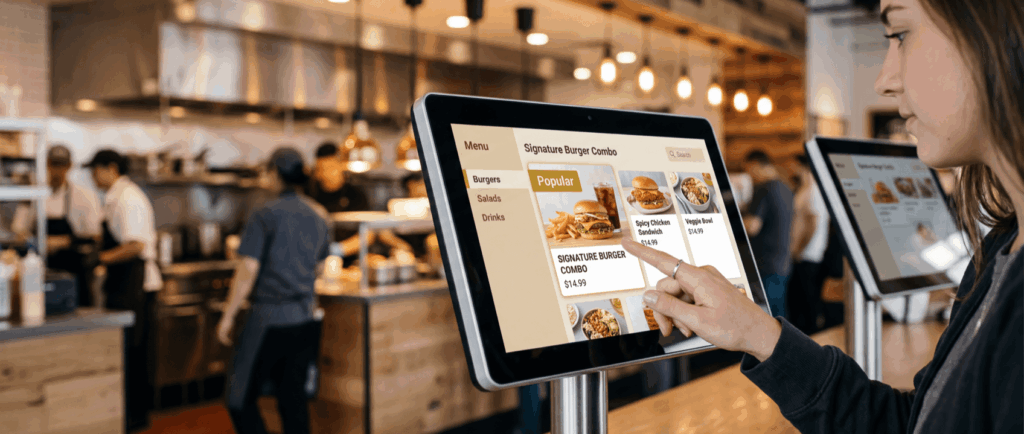
AI adjusts layout, highlights popular items, and tests placement changes to reduce decision fatigue. Over time, it can reveal which layouts reduce ordering errors and speed up decisions.
In kiosks and mobile ordering, AI helps guide customers through modifiers and options more clearly. This reduces incomplete orders, incorrect customizations, and staff intervention.
AI-assisted systems estimate preparation and waiting times based on current load and historical data. More accurate estimates reduce frustration caused by unrealistic expectations.
Efficiency alone does not guarantee a better experience. Overuse of prompts, excessive upselling, or poorly tuned interfaces can quickly turn convenience into annoyance.
Customer experience is often discussed abstractly, but AI’s contribution is mostly practical. Customers generally want consistency, recognition, and fewer problems rather than novelty.
AI helps identify patterns across visits, preferences, and feedback where sufficient customer data is available. This supports personalization that feels natural instead of forced. The goal is to make repeat visits smoother, not to surprise customers with excessive customization.
Common applications include:
The most effective implementations are subtle. Customers benefit without consciously noticing the technology behind it.
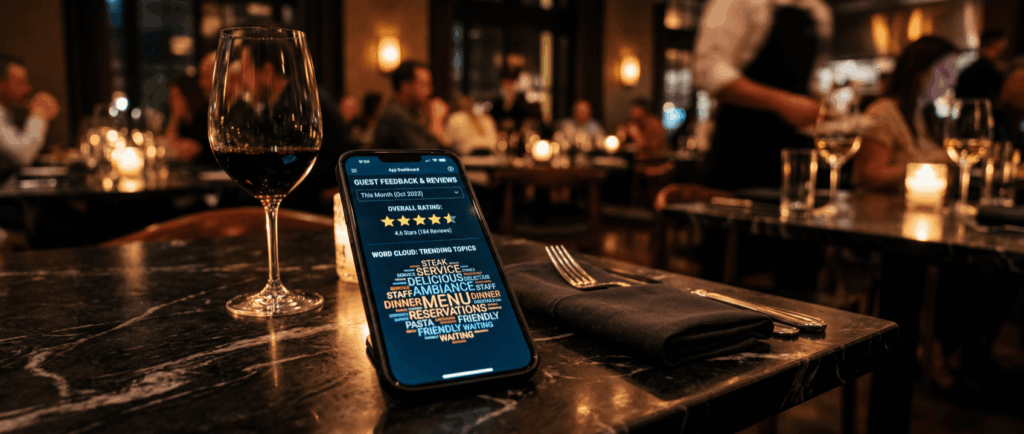
Restaurants receive constant feedback through reviews, ratings, and comments. The challenge is not collecting feedback, but synthesizing it in a meaningful way.
AI can analyze sentiment across large volumes of feedback and group comments by recurring themes. This helps distinguish isolated incidents from systemic problems that require operational changes.
Instead of reacting emotionally to individual reviews, managers gain a clearer understanding of what consistently affects satisfaction, reputation, and repeat business.
Top AI tools for restaurants vary widely not just in price, but in how much operational change they require. Some integrate cleanly with existing POS or inventory systems, while others expose data quality issues that need to be fixed before any value appears. Those hidden costs often matter more than the subscription itself.
ROI is strongest when the best AI software for restaurants is applied to repeatable, high-impact decisions such as inventory control, labor planning, and demand forecasting. These areas benefit from incremental improvements that compound over time. AI delivers far less value when adopted for branding or experimentation without a clear problem to solve.
Adoption tends to succeed when scope is controlled:
AI is only as reliable as the data it relies on. Inconsistent sales records, incomplete inventory tracking, or poorly structured inputs lead to recommendations that appear confident but are misleading in practice. This quickly erodes trust in the system.
There is also a risk of over-automation. Restaurants operate in dynamic environments where exceptions are normal, and rigid optimization can reduce flexibility when it is needed most. Some AI features look impressive in demos but fail under real kitchen pressure, where timing, people, and edge cases dominate.
AI works best when treated as a support tool rather than an authority. Human judgment remains essential for context, exceptions, and decisions that cannot be reduced to patterns alone.
AI works best in restaurants when AI for restaurants remains largely invisible. Its role is to reduce friction, support better decisions, and give teams more room to focus on service and consistency.
Used thoughtfully, AI does not replace hospitality. It supports it by reducing avoidable stress and uncertainty in an industry where both are already abundant.
At SiteValley, we know that modern restaurants rely on more than just a website. Online ordering systems, reservation platforms, analytics tools, and AI-driven dashboards all depend on fast, stable infrastructure that can handle real-world traffic spikes without failing during peak hours. That is why we focus on performance-oriented hosting built for production use, not hobby projects.
For restaurants implementing AI tools or running data-heavy back-office systems, we recommend our Cloud VPS KVM4-US plan with 4 vCPU cores, 8 GB RAM, and NVMe storage. This plan provides dedicated resources for running dashboards, APIs, and integrations reliably, with fast disk performance for databases and logs, and scalable capacity as your restaurant’s digital stack grows. It is a practical choice for operators who need consistency, low latency, and room to expand without overcomplicating their infrastructure.

Quick Customer care response, accurate and broad assistance, easy to use client area.....
I am very happy with the service. I am with site valley for many years and at the present usimg 2 hosting packages. Their service is excellent and super fast. Thanks & Greatly Appreciated
I've been hosting my websites with Sitevalley for more than 6 years. Very satisfied with the services and reliability they provide, competitive prices, almost no downtime, fast and knowledgeable customer support.
I have been using side valley for a couple of years now and have to say I am very happy with the service they offer.I use many Hosting services but site valley stands out in front. Reliable service, great support.I don't normally leave reviews but felt I wanted to for this service as it has been fantastic
I didn't want to review so soon on into taking out hosting with site valley but I feel obliged because their customer service is outstanding, second to none, every time I had an issue it was sorted immediately. I would highly recommend Site Valley.
I have been with Sitevalley for over a year and it's the best hosting I have EVER used. And I have been through a lot of them.
The support staff are amazing, and it's clear that they have a passion for hosting websites. I've rather enjoyed this webhosting company and it's stability for the price is bar-none, amazing.
My collegue adviced me to use SiteValley as a reliable hosting provider with great prices, professional and fast Customer Service. My experience with SiteValley was exactly the way I was promised.
I have been with SiteValley for many years, and plan to stay with them for many more. Customer support is very responsive and knowledgeable.
SiteValley.com is rated 4.8 / 5 based on 329 Reviews »

© 2001 – 2026 SiteValley.com. All Rights Reserved.
